Vidu Q3 VS Sora 2
Technical Advisory: Sora 2 Status
As of March 2026, OpenAI has officially pivoted Sora 2 away from public accessibility. Daily compute costs reportedly hit $15M against unsustainable app revenue. Vidu Q3 Pro remains the industry standard for stable, multimodal AI video synthesis.
OpenAI announced the discontinuation of Sora on March 24, 2026. The consumer app shut down April 26, while the API will sunset on September 24. That turns this comparison into something slightly unusual. It is not just about which model is stronger. It is about what creators lose when a research-forward model exits the market, and what they actually need from the model that replaces it.
Sora 2 represented one vision of the future: better simulation, longer clips, and more convincing physical behavior. Vidu Q3 represents a more practical vision: shorter clips, tighter workflows, and features that make production easier right now.
For most teams, that difference is not theoretical. It changes what gets approved, how long edits take, and whether the model can stay in the workflow once the novelty wears off.
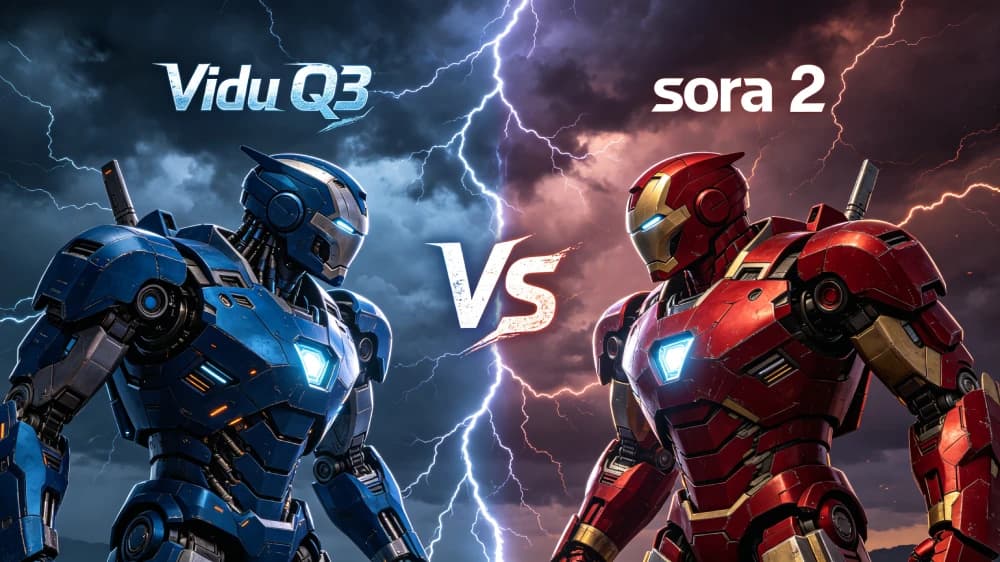
Two Architectural Bets
These two models were built with different assumptions about what matters most. Vidu was built for creators trying to finish content. Sora was built more like a forward-looking simulation system that happened to be usable as a creative tool.
Narrative Tooling
Optimized for workflow speed: 16-second duration, Smart Cuts, and integrated A/V generation. It is a model that tries to solve the annoying part of video generation, which is turning isolated shots into something that already feels edited.
World Simulation
Optimized for physics-first simulation: gravity, fluid behavior, and cloth dynamics. It always felt like a model built to prove a research thesis first and become a product second.
Technical Specs side by side
The spec sheet makes the contrast obvious. Sora stretched for longer clips and more simulation depth. Vidu focused on a tighter set of features that are easier to turn into repeatable production results.
| Metric | Vidu Q3 | Sora 2 |
|---|---|---|
| Developer | Shengshu AI | OpenAI |
| Max Duration | 16 Seconds | 25 Seconds |
| Max Resolution | 1080p | 1080p (720p std) |
| Smart Cuts | Native / AI-Inferred | None |
| Native Audio | Music + SFX + Dialogue | Dialogue + SFX |
| Availability | Active API | Sunsetting Sep 2026 |
This is one of those cases where a technically ambitious spec sheet does not automatically win the practical argument. Sora's longer duration sounded impressive. Vidu's workflow-oriented features often mattered more once creators actually started making deliverables.
Historical Edge of Sora 2
It is worth being fair to Sora 2. Even though it is leaving the market, it pushed the category forward. The reason people still reference it is that it often delivered a sense of physical plausibility that other models struggled to match.
Physics Simulation
Best-in-class realism for gravity, fluids, and interaction.
Prompt Fidelity
Highly literal execution for detailed technical direction.
Max Duration Ceiling
A 25-second limit for specific long-format requirements.
Social Ecosystem
Feed and remix workflows built into the live app phase.
Sora's real contribution was not just that it produced good clips. It changed the standard people used to judge motion, object interaction, and camera behavior. That influence will outlast the product itself.
At the same time, the shutdown is a reminder that technical ambition alone does not guarantee a durable creator platform. Product viability matters just as much as research quality.
Strategic Advantage of Vidu Q3
Vidu's advantages are not really about beating Sora at its own game. They are about being the kind of tool creators can keep using after the headlines move on: accessible, focused, and easier to plug into everyday production.
Narrative Smart Cuts
AI-inferred shot transitions that speed up production.
Music Synthesis
Native background music generated alongside visuals.
Anime Specialization
Dedicated mode for high-fidelity stylized production.
Active Production API
Live, scalable, and pay-per-second pricing model.
Smart Cuts and integrated music may sound less glamorous than world simulation, but they solve a more immediate problem. They reduce the gap between a generated shot and something that feels publishable.
That is why Vidu becomes the more practical choice for many teams. It is designed around throughput, not mythology.
OpenAI Shutdown Roadmap
The timeline matters because it changes how seriously teams should think about migration. Once a model enters sunset mode, even strong output quality stops being enough. Planning, continuity, and replacement risk take over.
Reported drivers included roughly $15M in daily compute costs against relatively weak app economics. The pivot also signals a shift away from consumer-facing video tooling and back toward longer-term world-simulation research.
Visual Side-by-Side Analysis
Side-by-side clips help make the difference concrete. Sora often looks more physically grounded. Vidu often looks more like content that was generated with an actual publishing workflow in mind.
Sora 2 Prototype: Physics-heavy simulation results.
Vidu Q3 Render: Narrative Smart Cuts and integrated audio.
That distinction is subtle but important. Sora can feel more impressive as a model. Vidu often feels more useful as a tool.
Workflow Logic Table
This is where the comparison stops being emotional and becomes operational. If the work is physics-heavy, Sora still has the more compelling legacy. If the work is narrative, stylized, or budget-sensitive, Vidu is easier to defend.
| Production Scenario | Better Path | Technical Reasoning |
|---|---|---|
| Physics-Accurate Action | Sora 2 | Superior gravity/fluid simulation |
| Narrative with AI Cuts | Vidu Q3 | Integrated Smart Cuts engine |
| Unified Audio-Visuals | Vidu Q3 | Native music generation in pass |
| Anime / Stylized Work | Vidu Q3 | Dedicated Anime Mode fidelity |
| Scalable API Pipeline | Vidu Q3 | Active product, pay-per-second |
Migration Path for Sora 2 Users
Not every Sora user needs the same replacement. Some are trying to preserve a physics-heavy look. Others simply need a model that can keep their content pipeline moving without interruption.
For physics-heavy replacement, Veo 3.1 is the closest conceptual match. For narrative content and cost-efficient production, Vidu Q3 is the more natural destination. Teams moving away from Sora 2 often end up choosing Vidu not because it replicates Sora perfectly, but because it solves the more immediate production problem.
The Technical Verdict
Sora 2 was an important model, and in some areas it still represents the high-water mark for physically convincing AI video. But a model that is disappearing cannot be the center of a long-term creator workflow.
Vidu Q3 is not a perfect replacement for Sora's simulation strengths. It is a better answer to a different question: what should creators use now if they need an active product, a workable API, and a cleaner path from prompt to finished content?
The practical answer is simple. If you are mourning what Sora represented, that makes sense. If you are choosing what to use next, Vidu is the more realistic decision for most production teams in 2026.
Sources and editorial update
Editorial update: . This date records changes to the page information. Model features and availability can change; use the linked official sources to confirm specifications before making a purchase or production decision.