Vidu Q3 VS HappyHorse 1.0
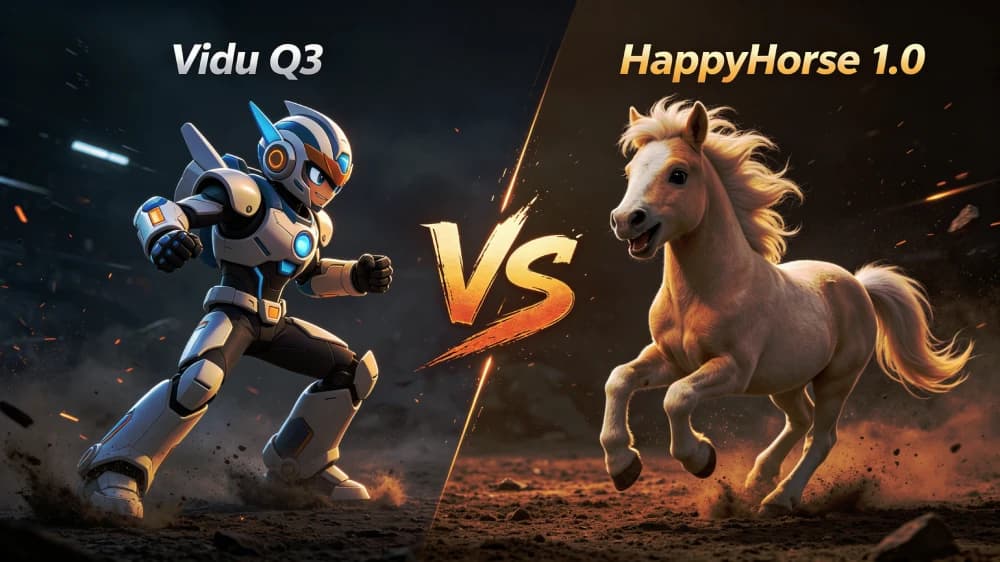
Vidu Q3 has been publicly available since early 2026, with a live API, clear pricing, and enough workflow features to make it usable beyond demos. HappyHorse 1.0 arrived later and generated attention for a different reason: in blind comparisons, it often looked better. That immediately made it relevant, even before the surrounding product story had fully caught up.
The practical difference is this: Vidu is easier to recommend when someone needs a tool they can actually build around today. HappyHorse is easier to recommend when someone is chasing the best-looking result and is willing to tolerate more uncertainty around access, deployment, or ecosystem maturity.
That is why this comparison matters. Plenty of creators do not need the single best benchmark score. They need to know which model is more likely to save time, reduce retakes, and fit the kind of projects they make every week.
Model Intelligence & Architecture
The architectural difference is not just a technical footnote. It helps explain why the two models behave differently under pressure. Vidu tends to favor usable sequencing and production logic. HappyHorse tends to favor output quality, especially when the prompt gives it enough detail to work with.
Vidu Q3
Latest generation of Shengshu Technology's large video model. Uses a U-ViT (Universal Vision Transformer) architecture focused on narrative video with integrated audio, which helps explain why it often feels more complete at the sequence level than at the single-frame level.
- 16s Max duration
- 1080p @ 24fps Native
- Integrated Native Audio
- Live API & Pricing
HappyHorse 1.0
A 15B parameter multimodal model from Alibaba's ATH AI unit. Uses a unified single-stream Transformer for text, image, video, and audio tokens, which points to a more tightly fused approach and likely contributes to its strong benchmark showing.
- Top Arena Elo Score
- Unified Architecture
- 7-Language Lip Sync
- Open-source Weights (TBD)
Visual Fidelity: 1080p Reality Test
Prompt: "A dog pilot in a cockpit, controlling a plane during takeoff, realistic motion, detailed cockpit controls, smooth camera movement."
Prompt: "A dog pilot in a cockpit, controlling a plane during takeoff, realistic motion, detailed cockpit controls, smooth camera movement."
On paper, both models look modern and competitive. In practice, Vidu comes across as a product. HappyHorse still reads more like a technically impressive model that may or may not settle into a stable product shape.
That distinction matters if you are making buying decisions for a team. Reliability, access, and support can outweigh raw model quality surprisingly quickly once deadlines enter the picture.
Technical Benchmarks: Elo Ratings
The numbers below explain why HappyHorse became impossible to ignore so quickly. It does not just edge out Vidu in public rankings. It opens a meaningful gap. That does not automatically make it the better production choice, but it does tell you the visual upside is real.
| Benchmark Category | Vidu Q3 Pro | HappyHorse 1.0 | Winning Edge |
|---|---|---|---|
| Text-to-Video (Visual Only) | ~1,050 | 1,366 | HappyHorse (+30%) |
| Image-to-Video (Visual Only) | ~1,020 | 1,399 | HappyHorse (+37%) |
| Text-to-Video (Native Audio) | ~1,060 | 1,230 | HappyHorse (+16%) |
| Image-to-Video (Native Audio) | ~1,040 | 1,168 | HappyHorse (+12%) |
The caution here is obvious but important: benchmark wins tell you which output people prefer when they see two results side by side. They do not tell you how many failed generations happened beforehand, how predictable the workflow is, or how easily a team can operationalize the model.
Strategic Advantages of Vidu Q3
Vidu's case is less about spectacle and more about day-to-day usefulness. If you are actually trying to produce a lot of video instead of just running comparisons, that makes a difference very quickly.
Production Ready
Live web app, public API, and transparent pricing available today.
16s Continuity
Supports up to 16 seconds in one pass, leading the industry in clip length.
Smart Cuts
Native shot planning that shifts shot types by scene content dynamically.
Multi-Reference
Advanced workflow for subjects, scenes, props, and style consistency.
Anime Mastery
Dedicated high-fidelity anime mode for stylized production workflows.
API Ecosystem
Available through Novita AI, Atlas Cloud, and official Vidu API.
The strongest argument for Vidu is not that it wins every category. It is that it reduces friction. Public access, established pricing, and a more complete workflow make it easier to budget, test, and repeat.
For agencies, internal teams, and solo creators who need predictable output, that kind of boring operational strength often matters more than a model being first on a leaderboard.
Strategic Edge of HappyHorse
HappyHorse earns its reputation the straightforward way: the output often looks excellent. It is one of the few recent models that immediately changed the conversation by making people ask whether the leaderboard leader was finally something new.
Visual Ceiling
Benchmark data shows a massive lead in pure image-to-video quality (1,399 Elo).
Multilingual Sync
Native lip-sync support for 7 languages including Mandarin and Cantonese.
Unified Stream
Audio and video are planned in one forward pass for superior multimodal coherence.
Open Weights
Confirmed future release of weights, potentially enabling local deployment.
If your buying logic starts with, "I want the model that gives me the highest visual ceiling right now," HappyHorse is the one that deserves the first serious look.
The open-weights angle also matters. Even if the timeline is still uncertain, the possibility of broader deployment options changes how developers and research teams evaluate its long-term value.
Production Use Cases
This is usually where the decision becomes clearer. Most teams are not picking a model in the abstract. They are picking for a recurring job: branded social clips, stylized shorts, internal prototypes, photoreal ads, or multilingual lip-sync content.
| Production Scenario | Optimal Tool | Technical Justification |
|---|---|---|
| Immediate Delivery Requirement | Vidu Q3 | Public access & credit system |
| Anime / Stylized Assets | Vidu Q3 | Native Anime Mode fidelity |
| 10-16s Narrative Sequences | Vidu Q3 | Superior context window |
| Character / Scene Consistency | Vidu Q3 | Advanced Reference-to-Video |
| Highest Photorealism Rank | HappyHorse 1.0 | Arena Leaderboard lead |
| High-Fidelity I2V Tasks | HappyHorse 1.0 | Record 1,399 Elo performance |
| Global / Localized Lip Sync | HappyHorse 1.0 | 7-language native engine |
| Self-Hosted API R&D | HappyHorse 1.0 | Confirmed weights release |
The table reads the way most real decisions look: Vidu wins more often when reliability and repeatability matter, while HappyHorse wins more often when the target is maximum visual quality and the team can afford a little more ambiguity.
Prompt Architecture
Prompting style is another place where the models diverge. Vidu tends to be more forgiving. HappyHorse seems to reward users who know how to describe a shot with more precision and who are comfortable being more explicit about visual intent.
Vidu Q3: Narrative Focus
Handles structured scene-level prompts with high semantic understanding. Its Smart Cuts feature interprets multi-beat stories even when instructions are concise.
HappyHorse: Technical Detail
Rewards highly granular technical descriptions—camera angles, specific lighting setups (e.g., "volumetric lighting"), and detailed motion vectors.
Motion Consistency & Prompt Adherence
Complex Action: "A surfer rides through sweeping ocean waves, dynamic motion, realistic water detail, smooth camera movement."
Complex Action: "A surfer rides through sweeping ocean waves, dynamic motion, realistic water detail, smooth camera movement."
Institutional Ecosystem
The institutional backdrop matters more than people sometimes admit. A strong model is one thing. A strong model with a stable product roadmap, support, and distribution is something else.
Vidu benefits from being easier to place inside a commercial workflow right now. HappyHorse benefits from the kind of research credibility and technical momentum that makes the market pay attention even before everything around the model is fully settled. In other words, one is easier to buy today, and the other is easier to be excited about.
Final Decision Framework
There is no single correct answer here, which is why this comparison keeps coming up. The right choice depends on whether you value dependable production more than peak output quality, or vice versa.
Vidu Q3
- • Immediate production delivery
- • Anime / Illustrated style needs
- • Clips > 10s in single pass
- • Predictable API costs
HappyHorse
- • Absolute peak visual quality
- • High-fidelity I2V workflows
- • Multilingual lip-sync needs
- • Future weights deployment
Monitor
- • Side-by-side technical tests
- • API stability (Post-April 30)
- • Open-source release timing
The Technical Verdict
Vidu Q3 is the easier recommendation for people who need a tool now. It is more accessible, easier to budget for, and better suited to teams that care about stable workflow more than benchmark bragging rights.
HappyHorse 1.0 is the more interesting recommendation for people chasing the highest current visual ceiling. The benchmark lead is not trivial, and the model clearly has the kind of output quality that can shift buying decisions on its own.
Put simply: if you are optimizing for a working production system, choose Vidu. If you are optimizing for the best-looking result and can tolerate more uncertainty around the surrounding product story, HappyHorse deserves the closer look.
Sources and verification
Specifications and availability were checked on September 12, 2026. Model features can change, so confirm current details on the providers' official pages before making a purchase or production decision.