Vidu Q3
Focused short-form audio-video creation
- Up to 16 seconds
- Up to 1080p
- Native audio-video
- Text to Video
- Image to Video
- Reference to Video
- First & Last Frame
- Detailed camera control
Vidu Q3 and Wan 3.0 both create synchronized audio-video content, but their workflows are very different. Compare duration, image and reference control, editing, camera direction, consistency, and practical use cases before choosing a model.
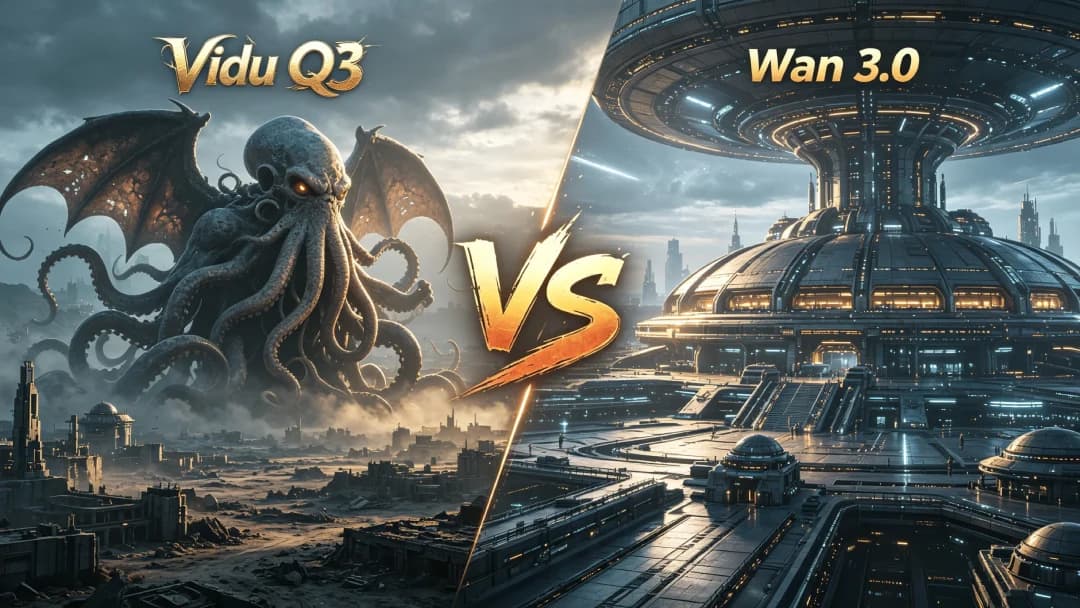
Choose Vidu Q3 if you primarily create short, polished clips and want a focused workflow for native audio, image-to-video generation, first-and-last-frame control, image references, ads, anime, and social content.
Choose Wan 3.0 if you need longer 30-second generations, broader input types, video references, document-to-video workflows, or the ability to modify visuals, story elements, and dialogue after generation.
Vidu Q3 is more focused around creating and refining individual shots. Wan 3.0 moves further toward an all-in-one production workflow where many different types of source material can become a longer generated video.
| Feature | Vidu Q3 | Wan 3.0 |
|---|---|---|
| Maximum single generation | Up to 16 seconds | Up to 30 seconds |
| Maximum listed output resolution | 1080p | 1080p |
| Native audio-video | Yes | Yes |
| Text to video | Yes | Yes |
| Image to video | Yes | Yes |
| Reference to video | Yes | Yes |
| Image references | Up to 7 in Q3 reference workflows | Supported |
| Video reference input | Not a core Q3 reference input | Supported |
| Audio input/reference | Native audio generation; workflow dependent | Supported as an input |
| First and last frame | Yes | Not the main differentiating workflow |
| Document input | No | Yes |
| Video editing | Generation-focused workflow | Built-in editing |
| Camera control | Detailed camera movement and pacing | Cinematic generation and editing controls |
| Best fit | Short-form shots and focused creation | Longer and input-heavy production workflows |
Focused short-form audio-video creation
Longer multimodal creation and editing
The most important difference in the Vidu Q3 vs Wan 3.0 comparison is not whether either model can generate attractive AI video. Both are designed for modern audio-video creation. The larger difference is how much of the production process each model tries to handle inside one workflow.
Vidu Q3 focuses on complete short-form shots. It can generate video with synchronized dialogue, voiceover, sound effects, and music, while supporting text-to-video, image-to-video, reference-based generation, and first-and-last-frame workflows. A single generation can run for up to 16 seconds.
Wan 3.0 expands the idea into a broader production system. It can generate up to 30 seconds in one pass and accepts text, images, audio, video, and documents as source material. It also includes editing capabilities for changing elements of an existing result rather than always starting over.
That makes the choice relatively straightforward.
Vidu Q3 is compelling when your project is built from focused shots and you want strong control over each generated scene.
Wan 3.0 becomes more attractive when a single generation needs to absorb more source material, run longer, or remain editable afterward.
Vidu Q3 is a native audio-video generation model designed around creating complete short scenes in one generation.
Its workflow combines visuals and sound rather than forcing creators to generate silent footage first and build the audio layer separately. Dialogue, voiceover, sound effects, music, visual motion, and camera direction can all contribute to the same generated scene.
Vidu Q3 supports videos up to 16 seconds and output options up to 1080p. The Q3 family also covers text-to-video, image-to-video, reference-to-video, and first-and-last-frame workflows.
For reference-based creation, Vidu Q3 can work with multiple image references to help maintain recognizable characters, products, objects, and visual identity.
This makes Vidu Q3 especially practical for creators who think in shots: generate one scene, review the motion and sound, refine it, then combine multiple successful scenes during editing.
That workflow fits ads, anime, product videos, cinematic shots, dialogue scenes, social clips, and short narrative content particularly well.
Wan 3.0 is a multimodal AI video generation model designed to create longer videos from a wider range of source material.
A single Wan 3.0 generation can reach 30 seconds, nearly doubling the maximum single-generation duration of Vidu Q3.
Its defining feature is the breadth of its input system. Wan 3.0 can work with text, images, audio, video, and documents. Supported document-oriented workflows can use material such as presentations, PDFs, text files, and spreadsheets as creative source information.
That changes what an AI video prompt can look like.
Instead of manually turning a presentation, report, script, image collection, reference clip, and audio source into one carefully compressed text prompt, creators can provide richer source material directly.
Wan 3.0 also adds built-in video editing capabilities. Existing generated content can be revised by changing visual elements, plot details, or dialogue without treating every change as an entirely new creative task.
For longer storytelling and source-heavy production, that broader workflow is its main advantage.
Video duration is one of the clearest differences.
Vidu Q3 supports up to 16 seconds in one generation.
Sixteen seconds is already enough for many practical AI video tasks:
Wan 3.0 supports up to 30 seconds in one generation.
That additional duration matters when several actions need to remain part of the same continuous narrative. A character can enter a location, interact with another subject, speak, move through the environment, and reach a more complete ending without requiring as many separately generated clips.
A longer maximum does not automatically produce a better video. Shorter shots can be easier to control and replace during editing.
The real question is how you prefer to build your sequence.
Both models support text-to-video generation.
With Vidu Q3, prompts work well when they describe a clearly directed shot.
A useful structure is: Subject + Action + Environment + Camera + Lighting + Style + Sound
The goal is to make the intended shot easy to understand.
Vidu Q3's shorter generation window makes this approach particularly natural. Instead of asking for an entire film sequence, the creator describes one coherent moment.
Wan 3.0 can use the same kind of prompt, but its longer duration gives the model more room for narrative progression.
A Wan 3.0 prompt can describe several connected events, changes in scene direction, dialogue, or a more developed beginning-to-end sequence.
For a single cinematic shot, both workflows can make sense.
For a longer text-driven sequence that would otherwise require several individual generations, Wan 3.0 has the duration advantage.
A woman in a dark blue coat walks through a quiet train station at night, light rain visible beyond the glass roof, camera slowly tracks backward in front of her, cinematic reflections across the floor, distant station announcements and footsteps.
Image-to-video generation starts with a stronger visual anchor than text alone.
The image can establish the character, product, environment, composition, clothing, illustration style, or overall visual identity. The prompt then focuses more heavily on movement.
Vidu Q3 works especially well with this shot-oriented approach.
Upload a starting image and describe: subject movement camera movement expression environmental motion lighting changes dialogue sound effects
For example, a product image can become a slow commercial reveal, while an anime illustration can become a character shot with controlled facial expression, hair movement, and camera motion.
Wan 3.0 also supports image-to-video, but its advantage grows when the image is only one part of a larger set of instructions.
If the project also relies on reference video, audio, additional source material, or longer narrative development, Wan 3.0 can combine those inputs into a broader workflow.
For straightforward image animation, Vidu Q3 offers a focused path.
For more complex multimodal production, Wan 3.0 provides more room to combine different forms of creative guidance.
Reference control matters when text alone cannot communicate exactly what should appear in the final video.
Vidu Q3 supports reference-to-video generation using image-based subjects and references. The workflow can use up to seven reference images, allowing creators to establish recurring characters, products, objects, or visual identities.
For character work, several clear views of the same subject may be more useful than repeatedly describing facial features in a prompt.
For product work, references can communicate shape, material, proportions, branding, and details that should remain recognizable.
Wan 3.0 takes a broader multimodal approach.
Its input system can combine visual, video, audio, and other source information. This makes it useful when the reference is not simply about what a character looks like.
A reference video might communicate motion. Audio can contribute another part of the intended experience. Additional source material can communicate story or context.
This produces an important workflow difference.
Both models belong to the newer generation of AI video tools where sound is part of the generation workflow rather than an afterthought.
Vidu Q3 can create visuals together with dialogue, voiceover, sound effects, and music.
That is particularly useful for short narrative scenes.
A door closes and produces the expected sound. Two people exchange dialogue. Footsteps match a character walking across the frame. Background ambience supports the environment.
The audio and visual event are designed to belong to the same moment.
Wan 3.0 also supports audio-visual workflows and accepts audio as part of its broader multimodal input system.
The distinction is therefore not simply: Which model has audio? Both do.
A more useful question is: How much source material needs to influence the finished audiovisual sequence?
For a focused scene with generated dialogue and sound, Vidu Q3 provides a direct workflow.
For a larger production where audio joins video, images, documents, and other inputs, Wan 3.0 offers a broader input structure.
Camera language is important because AI video quality is not only about sharp individual frames.
Movement determines whether the result feels intentionally directed.
Vidu Q3 places strong emphasis on camera movement and pacing. Creators can write prompts around tracking shots, push-ins, pullbacks, pans, tilts, orbital movement, static framing, and the timing of visual events.
This fits a shot-based production workflow.
Instead of asking for “cinematic motion,” describe exactly what the camera should do.
For example, the camera begins close to the product label, slowly pulls backward while orbiting clockwise, revealing the complete bottle on a reflective stone surface.
That is much easier to evaluate and refine than an undefined request for a dramatic commercial shot.
Wan 3.0 also targets cinematic generation, but combines generation with a broader editing workflow.
If your main concern is directing a specific generated shot, Vidu Q3 is a strong fit.
If your production requires longer sequences followed by further revisions to the generated video, Wan 3.0 may provide the more complete workflow.
The camera begins close to the product label, slowly pulls backward while orbiting clockwise, revealing the complete bottle on a reflective stone surface.
This is one area where Vidu Q3 has a particularly useful dedicated workflow.
First-and-last-frame generation lets the creator provide the beginning and ending visual state and ask the model to generate the motion between them.
It also changes how you prompt. Instead of describing both the starting composition and final composition from scratch, the two images establish those endpoints visually. The prompt can concentrate on how the transition should happen.
Wan 3.0 offers broader multimodal creation and editing capabilities, but first-and-last-frame generation is a more explicit part of the Vidu Q3 workflow.
If controlling two visual endpoints is central to the project, that can be a meaningful reason to choose Vidu Q3.
One capability creates a very clear distinction between Wan 3.0 and Vidu Q3: document input.
Wan 3.0 can accept document-based source material in addition to more traditional AI video inputs.
This creates a different type of use case.
Imagine a company already has a PowerPoint presentation, a PDF report, a training document, a product brief, a spreadsheet, and written campaign material.
A traditional AI video workflow requires someone to read that material, extract the important information, rewrite it as a video concept, and then turn that concept into prompts.
A document-to-video workflow can reduce some of those intermediate steps by allowing the source material itself to contribute to generation.
That makes Wan 3.0 particularly interesting for training content, internal communications, presentation-to-video workflows, sales materials, report summaries, and information-heavy business content.
Vidu Q3 is not designed around document ingestion.
Its strength remains focused audiovisual shot generation rather than converting business files into video source material.
For creators primarily working from prompts and visual references, document input may not matter.
For teams with large libraries of presentations and reports, it can be a significant difference.
The models also differ in what happens after a generation is created.
Vidu Q3 is primarily centered on generation and iteration.
If a result is close but not right, creators can adjust the prompt, references, endpoints, or other available controls and generate another version.
This is efficient for individual shots because replacing one short clip is relatively manageable.
Wan 3.0 moves further into instruction-based video editing.
Its workflow is designed to modify elements such as visuals, story details, or dialogue without treating the entire production as a fresh generation.
This becomes more important as videos get longer.
Replacing a five-second shot is one thing. Regenerating an otherwise successful 30-second sequence because one part is wrong can be much more expensive creatively.
For that reason, editing depth and maximum duration work together as part of Wan 3.0's larger production philosophy.
Character consistency is one of the hardest areas to reduce to a single model score.
Results depend on source image quality, number of characters, camera angle, lighting, clothing changes, scene complexity, motion, occlusion, duration, and quality of reference material.
Vidu Q3 can use image references to define subjects across generated scenes, making it useful for ads, anime characters, short dramas, and recurring visual identities.
For projects where the subject can be clearly represented with a small set of strong images, this is a practical workflow.
Wan 3.0 emphasizes reference-to-video consistency across characters, props, spaces, and style while also accepting more kinds of source material.
That broader input system may help when the production has more moving parts.
The practical recommendation is not to choose a model solely because one platform claims better consistency.
Test your actual character, product, lighting, and camera conditions.
Consistency is a workflow problem as much as a model feature.
Vidu Q3 is particularly well suited to short animation and anime-oriented workflows.
An existing illustration can become a moving character shot with controlled camera direction, dialogue, environmental sound, and subtle character animation.
For stylized work, small intentional motion often produces a more usable result than trying to animate every element in the frame.
Vidu Q3's short-form structure fits this type of scene creation well.
Wan 3.0 may become more useful when the anime project needs a longer sequence, several source types, more story progression, or post-generation revisions.
Advertising is another category where the workflow matters more than the model name.
Vidu Q3 works naturally for shot-based advertising.
A typical workflow might generate an opening lifestyle shot, a product close-up, a usage moment, a reaction shot, and a final hero product shot. Each scene can be refined individually before the clips are assembled.
This is useful for social ads, ecommerce visuals, product reveals, campaign testing, and short-form branded content.
Wan 3.0 can take a different approach.
Its longer generation window and broader source system make it better suited to building more of the campaign narrative inside one generation.
Document input may also be useful when commercial teams already have product documentation, presentations, or campaign briefs.
Neither approach is universally better.
Use Vidu Q3 when precise individual shots are the building blocks. Use Wan 3.0 when the model needs to consume more campaign material and generate a longer connected sequence.
There is no universal winner.
The choice is less about finding one model that wins every benchmark and more about deciding how much of your production workflow you want the model to handle.
Vidu Q3 and Wan 3.0 solve overlapping problems, but they approach AI video production from different directions.
Vidu Q3 is a focused short-form creator.
Its combination of native audio-video generation, image-to-video, reference images, first-and-last-frame control, camera direction, and up to 16-second output makes it a strong fit for creators building polished shots for ads, anime, social media, products, and cinematic sequences.
Wan 3.0 is broader.
Its 30-second generation length, support for text, image, audio, video, and document inputs, reference consistency, and built-in editing push it toward a more complete production environment.
So, is Vidu Q3 better than Wan 3.0?
Choose Vidu Q3 when control over individual short-form shots and a focused creative workflow matter most.
Choose Wan 3.0 when your project needs longer generation, richer source inputs, document-to-video, or deeper editing inside the generation workflow.
For many creators, Vidu Q3 will remain the simpler way to build individual shots.
For more complex source-heavy production, Wan 3.0 offers the broader toolset.
It depends on the project. Vidu Q3 is well suited to short-form shots, image-to-video, native audio, image references, first-and-last-frame generation, anime, ads, and social content. Wan 3.0 is better suited to longer 30-second generations, broader multimodal input, document-to-video workflows, and built-in editing.
The biggest differences are maximum duration and workflow breadth. Vidu Q3 supports up to 16 seconds and focuses heavily on controllable short scenes. Wan 3.0 supports up to 30 seconds and accepts a wider range of source material, including documents, while also providing video editing capabilities.
Vidu Q3 supports videos from 1 to 16 seconds depending on the selected Q3 model and workflow.
Wan 3.0 supports up to 30 seconds in a single generation and also includes video extension capabilities.
Yes. Both support audio-video workflows rather than being limited to silent video generation. Vidu Q3 can generate dialogue, voiceover, sound effects, and music together with the video.
Vidu Q3 is a strong choice for turning a single image into a focused short video with camera and audio direction. Wan 3.0 may be a better fit when that image is only one part of a larger multimodal production.
Both models support reference-based workflows. Vidu Q3 can use up to seven images in its reference-to-video workflow, while Wan 3.0 uses a broader multimodal input system that can also incorporate other types of source material.
Yes. Vidu Q3 includes first-and-last-frame workflows that let creators define the visual start and end of a generated sequence.
Yes. Wan 3.0 supports document-based inputs, including formats used for presentations, PDFs, text documents, and spreadsheets, within its everything-to-video workflow.
Wan 3.0 includes built-in editing capabilities designed to modify visual elements, plot details, and dialogue without always regenerating an entire concept from scratch.
Vidu Q3 is a strong fit for short anime shots and animating existing illustrations. Wan 3.0 may be preferable when the project needs a longer anime sequence, more source types, or more extensive editing.
Vidu Q3 is well suited to individual product shots, social ads, hooks, and short campaign scenes. Wan 3.0 is attractive for longer story-driven advertisements and projects that need to combine many source materials.
Both provide tools for reference-driven consistency. Vidu Q3 offers a focused image-reference workflow, while Wan 3.0 emphasizes consistency across characters, props, spaces, and style in a broader multimodal workflow. Actual results should be tested with the specific subject and scene.
Do not assume that Wan 3.0 is an open-source release simply because earlier Wan models have public repositories. The current Wan 3.0 product should be described according to its available Model Studio implementation unless an official Wan 3.0 open-weight release is separately confirmed.
Yes. Wan 3.0 is a strong alternative if you need longer video generation, document input, broader multimodal inputs, or built-in editing. Vidu Q3 remains a strong choice for shorter shot-based workflows.
If your workflow is built around short cinematic scenes, image animation, reference-driven characters, first-and-last-frame transitions, native audio, anime, ads, or social content, start with Vidu Q3.
Create one focused shot, review the movement, composition, consistency, camera direction, and sound, then refine the result until it fits your sequence.
Editorial update: . This date records changes to the page information. Model features and availability can change; use the linked official sources to confirm specifications before making a purchase or production decision.
Vidu Q3 vs Wan 3.0 for Social Media
For TikTok, Instagram Reels, YouTube Shorts, and other social formats, 30-second generation is not automatically an advantage.
Many short-form videos depend on fast cuts.
A strong opening shot may last only two or three seconds. The product shot might last four seconds. A reaction might last another two seconds.
In this type of editing workflow, Vidu Q3's 16-second maximum is rarely the limiting factor.
Generating separate scenes also makes it easier to replace a weak shot without disturbing the rest of the edit.
Wan 3.0 is more useful when you want a longer social sequence generated as one connected story rather than assembled from several smaller clips.
So the decision comes down to editing style.