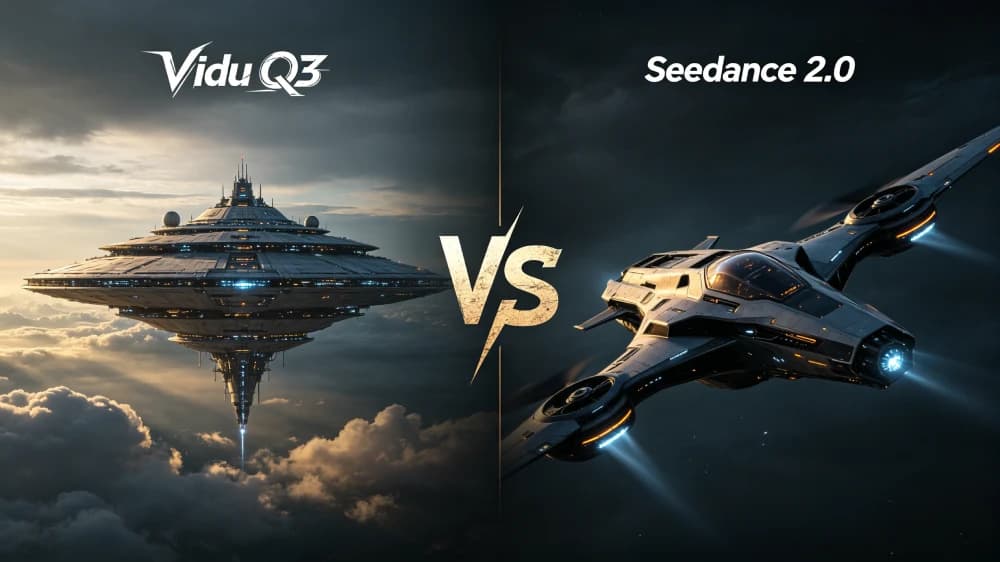
Vidu Q3 VS Seedance 2.0
The AI video market had a relatively settled hierarchy for most of early 2026. Then two models landed within weeks of each other and reshuffled the deck. Vidu Q3 arrived with 16-second continuity and a workflow that made sense for creators who needed output fast. Seedance 2.0 arrived with a different pitch: deeper control, more input flexibility, and stronger visual performance in direct comparisons.
That is why the comparison is more interesting than a simple benchmark table. Seedance is the model people point to when they want the best-looking result. Vidu is the model people point to when they need something they can keep using day after day without overcomplicating the process.
In other words, this is not only a quality comparison. It is a workflow comparison. The right answer depends on whether you care more about raw output ceiling or about how quickly you can go from prompt to usable clip.
Model Intelligence & Specs
Specs matter, but only if they explain behavior. The practical questions are more grounded: how much detail survives movement, how often the model misses the point of the prompt, and how much work is left after the first render.
Vidu Q3
U-ViT architecture focused on narrative continuity and integrated audio. It is a model designed around getting a whole scene to feel coherent rather than maximizing image quality in a single frame.
- 16s Max duration
- 1080p @ 24fps Native
- Narrative Smart Cuts
- Live Public API
Seedance 2.0
ByteDance's unified multimodal engine. Capable of processing up to 12 different file references in one pass, which makes it much more flexible for creators who already work with multiple assets and want tighter control over the final result.
- 2K Resolution Ceiling
- 12-Reference Input Flow
- 8+ Language Lip Sync
- Unified A/V Architecture
| Metric | Vidu Q3 | Seedance 2.0 |
|---|---|---|
| Max Resolution | 1080p | 2K |
| Max Duration | 16 Seconds | 15 Seconds |
| Architecture | U-ViT Transformer | Unified Multimodal |
| Lip Sync | Native Support | 8+ Languages |
| Edit Control | Smart Cuts | Director-Level |
The most important difference here is not one extra second of duration. It is the trade between control and convenience. Seedance gives you more ways to shape the result. Vidu asks you to do less up front.
That makes Seedance more attractive to teams with established creative workflows, while Vidu is easier to recommend to solo creators or smaller teams that need speed more than precision.
Arena Performance Benchmarks
This is the section that explains why Seedance 2.0 became such a serious competitor so quickly. The gap is not minor. In several public benchmark categories, it is comfortably ahead.
| Benchmark Category | Vidu Q3 Pro | Seedance 2.0 | Elo Gap |
|---|---|---|---|
| Text-to-Video (Visual Only) | ~1,050 | 1,270 | +220 |
| Image-to-Video (Visual Only) | ~1,020 | 1,346 | +326 |
| Text-to-Video (With Audio) | ~1,060 | 1,223 | +163 |
| Image-to-Video (With Audio) | ~1,040 | 1,182 | +142 |
The usual caveat applies. Elo is a strong signal for perceived quality, but it does not tell the whole story. A model can lose side-by-side votes and still be the better fit if it is cheaper to run, easier to prompt, and more predictable under deadline pressure.
Strategic Edge of Seedance 2.0
Seedance is easiest to justify when the output itself is the priority. It has the kind of visual quality lead that matters for commercial work, higher-end client presentations, and any project where softness or instability is immediately visible.
2K Visual Ceiling
Leads by a clear margin in benchmark outcomes with 2K output flexibility.
Multimodal Depth
Up to 12 file references (video, audio, image) in one generation flow.
Platform Reach
Available on Dreamina, CapCut, and fal.ai commercial ecosystems.
Physics Accuracy
High reliability in simulating cloth, fluid, and complex object interactions.
Advanced Lip Sync
Native 8+ language engine for synchronized dialogue production.
The multimodal input system is probably the most meaningful advantage. It changes the way a generation can be directed. Instead of relying on text alone, you can assemble references the way a real production workflow often does.
That does not automatically make Seedance the right answer for everyone. But it does make it the more capable option when the work depends on precise control over subject, motion, and style all at once.
Production Logic of Vidu Q3
Vidu's strengths are easier to appreciate once you stop comparing only still frames. Its case is about production rhythm: longer single-pass clips, built-in shot planning, stylized output, and fewer moving parts around the generation itself.
16s Continuity
The longest single-clip duration in the production model category.
Smart Cuts
Automatic cinematic edit points inferred from narrative prompt content.
Anime Mastery
Dedicated high-fidelity mode for stylized and illustrated production.
Unified SFX
Background music, SFX, and visuals generated in one coherent pass.
Cost Volume
Highly competitive per-second pricing for enterprise-scale generation.
Smart Cuts are a good example of the difference in philosophy. Seedance gives you more explicit control. Vidu tries to help you arrive at a coherent piece of content more quickly, even if that means giving up some precision.
For short-form narrative content, that tradeoff is often worth it. The output may not always win a blind beauty contest, but it can still be the better production decision.
Visual Side-by-Side Comparison
Side-by-side tests are useful because they expose where each model feels natural and where it still feels synthetic. In this sort of comparison, Seedance usually looks more polished. Vidu often looks more immediately usable for lightweight narrative content.
Prompt: "The girl in the picture turns around under the cherry blossom tree."
Prompt: "The girl in the picture turns around under the cherry blossom tree."
This is also where personal preference starts to matter. Some users will prefer Seedance because it looks more refined. Others will prefer Vidu because the result already feels closer to a finished social clip instead of a raw visual output.
Production Framework
Most teams do not need a philosophical answer to which model is better. They need a buying answer. That usually comes down to what kind of output they repeat most often and how much control their workflow really benefits from.
| Production Scenario | Optimal Tool | Technical Logic |
|---|---|---|
| Highest Visual Fidelity Rank | Seedance 2.0 | Large Elo lead & 2K output |
| Multi-Reference Content Flow | Seedance 2.0 | 12-file input system |
| Advanced Physics Reliability | Seedance 2.0 | Stable fluid & cloth simulation |
| Anime / Illustrated Projects | Vidu Q3 | Native Anime Mode fidelity |
| Narrative with Narrative Cuts | Vidu Q3 | 16s window + Smart Cuts |
| Unified Audio-Visual Synthesis | Vidu Q3 | Music + SFX in one pass |
| High-Volume Social Media | Vidu Q3 | Competitive per-second cost |
Cost Analysis
Price comparisons are often misleading because they ignore retry cost. The more relevant number is not price per second. It is cost per usable clip. If one model produces cleaner outputs on the first or second try, that advantage compounds quickly.
Where Seedance justifies the cost
Seedance makes the most sense when quality affects client perception, brand polish, or how much post work is needed. In those contexts, paying more for a better first result can be rational.
Where Vidu is easier to scale
Vidu is easier to defend for repeated content generation. If the work is narrative, stylized, or social-first, the workflow savings often matter more than losing some quality in direct head-to-head comparisons.
Access Advisory
Access stability matters more than most benchmark discussions admit. A stronger model is less useful if access is inconsistent, regional, or dependent on third-party routing that may change over time.
Seedance 2.0
Seedance has broader technical capability, but availability has been more tied to partner platforms and regional rollout decisions. That is manageable for some teams and a genuine risk for others.
Vidu Q3
Vidu is easier to trust operationally because the access story is clearer. If your team values predictable availability over maximum experimental flexibility, that alone can tip the decision.
Technical Verdict
If visual quality is your first priority, Seedance 2.0 is the stronger model. The benchmark lead is real, the multimodal input system is more sophisticated, and the ceiling is clearly higher when the goal is polished output.
If workflow speed, accessibility, and narrative usefulness matter more, Vidu Q3 is still the easier recommendation. It is the more practical choice for creators who need a model they can keep using without building an elaborate production stack around it.
The short version is simple. Seedance is the quality-first answer. Vidu is the production-first answer. Which one is better depends less on abstract capability and more on what kind of work you need to finish this month.
Sources and verification
Specifications and availability were checked on September 12, 2026. Model features can change, so confirm current details on the providers' official pages before making a purchase or production decision.